

Data integration across company systems
Figures from production, the warehouse and accounting do not match, and the report for management is put together by hand? We connect data from systems by different vendors where it is already readable into one whole you can trust.
What you get with this service
The nine topics you ask about most. Open whichever interests you – the details and answers are inside.
One data model
We turn ten sources into one model you can actually work with.
Every system speaks differently: a different format, different names for the same thing, a different structure. Mapping into one model is most of the work – and without it nothing else can be built.
- What if a source has no API?
- We also handle exports, database dumps, e-mail attachments and, as a last resort, reading from the web or from images – a photo of a meter, a screen or a scanned document, for instance, which today works reasonably reliably. What matters is that access is stable and legal, not how it works.
- Can you read data directly from machines?
- We work with data that is already readable somewhere – in a database, an export or the API of the system that runs the machines. Connecting directly to machine controls is work for the machine supplier or its integrator; we agree with them on how the data is handed over.
Record matching
We recognise the same entity under a different ID and a differently written address.
We match using rules as well as similarity. Borderline cases are confirmed by a person, so we never blindly merge two of your customers into one.
Quality checks and provenance
If a source starts delivering nonsense, you hear it from us.
An export gets a new column, an API changes its structure, a website stops responding. Validation on input and output catches it before an output someone relies on breaks.
For every value we record where it came from, when it was loaded and how it was calculated. Without that, nobody in the company will trust the data – and rightly so.
No more manual retyping
Data moves between systems on schedule and repeatably, with no one having to step in.
This is the most common reason we take on processing at all. You get the result as an API, an export to other systems or reports that generate themselves.
- Do we have to change our systems for this?
- No. Your systems stay as they are; we take the data from wherever it is already readable. If you also want a tool people work in – records, approvals or forms – that is a custom information system, and we connect it to the unified data.
- Who on our side should be in charge?
- One person who knows where your data comes from and one who decides what they want to see in it are enough. We take care of the technical part, talking to your system vendors about access, and running it.
Millions of records
Processing in batches, with a record of every run.
When a rule changes, we replay the history – no manual digging. We build on proven open source, not a black box.
- What technologies do you use?
- PostgreSQL, Node.js, Python, Elasticsearch and Redis. Runs are scheduled to suit the environment – from cron to Airflow.
A foundation for AI and search
Unified data is a precondition for a model or search to make sense.
Without it, a model guesses with confidence and search returns three versions of the same thing. That is why data processing is often the first step before AI integration.
AI integration- Will we then be able to ask the data questions in plain language?
- Yes. On top of the unified data we build an assistant that answers with a link to the source, or a search that finds even what you cannot name precisely. It is the most common next step.
How we roll it out
One question and one output. Once it works, more are added.
-
Source analysis We pick one question nobody can answer quickly today – a report put together by hand, for instance – and go through the sources it can be built from. That gives us the data model, scope and price.
-
Pipeline and checks Collection, cleaning, matching and validation – automatic, repeatable and with a record of every run.
-
Operation and development Monitoring of runs, reporting of anomalies and adding more sources or outputs as needed.
What it costs
We quote a price after analysing the sources: how many there are, in what quality and how often they change.
The first question and the first output show within weeks what working with the data is like, and you decide whether to continue. Further sources are then priced on what we actually find, not on an estimate.
Operation and more sources
Run monitoring, anomaly reporting and capacity for more sources.
Processing that runs every day needs someone watching over it. That can be us – but the process and rules are documented and run on your side.
Operation, support and developmentData we process
Collection from dozens of sources, cleaning and unification – in some projects this runs every day.
All our references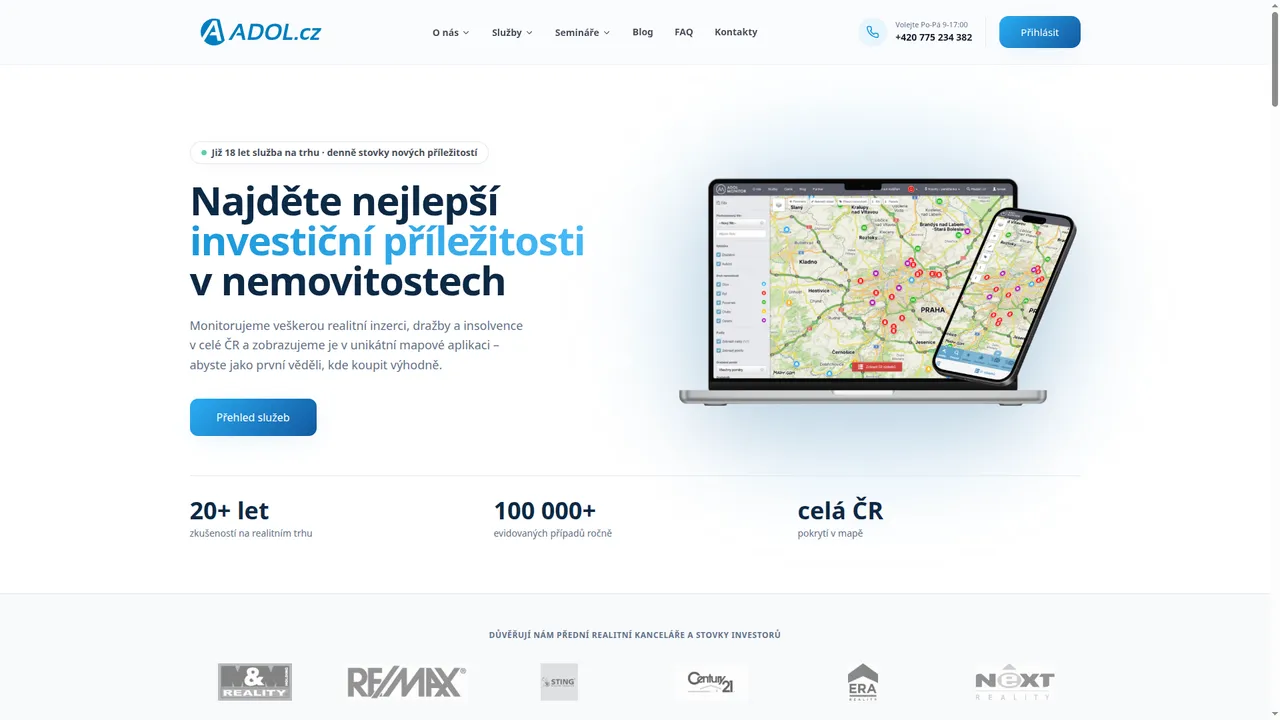
Adol Monitor
Monitoring of property auctions and enforcement sales – automatic data collection from dozens of sources, merged into one place, and a watchdog for clients.
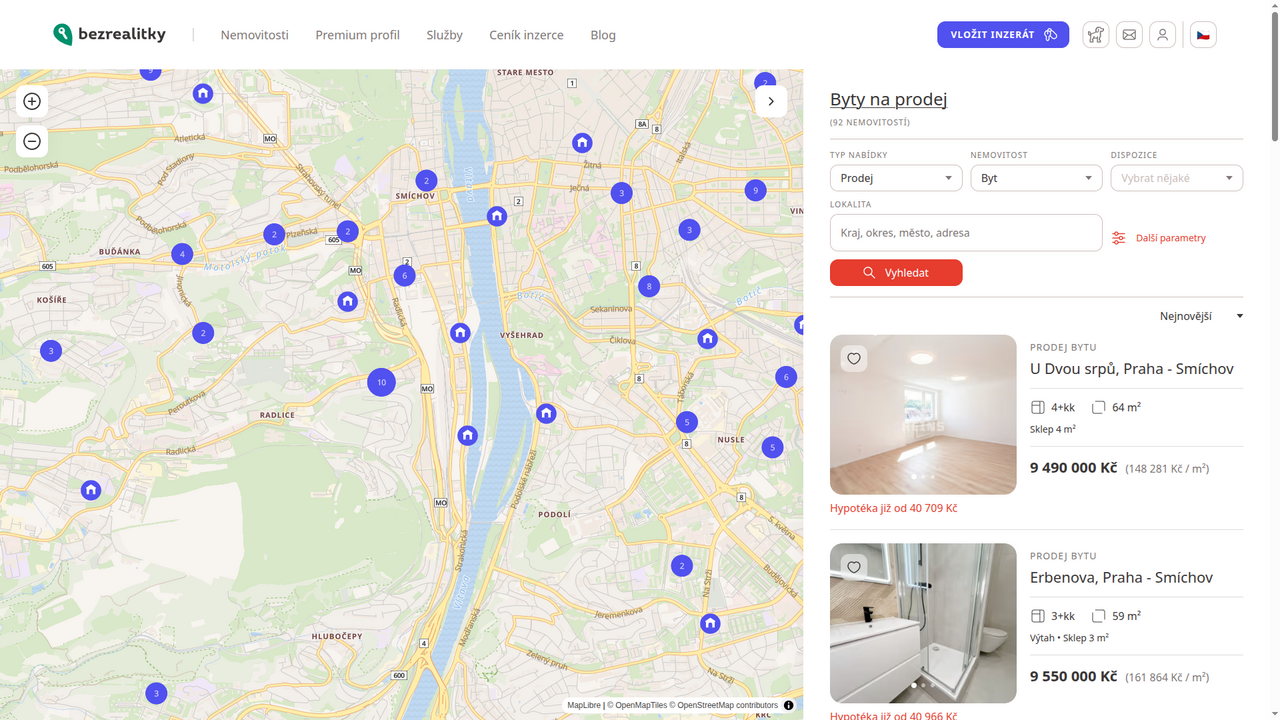
Bezrealitky
The most successful real estate portal for selling and renting property directly from owners. We have been developing it continuously since 2007 and keep it running under the load of tens of thousands of people a day.
Why bring it to us
Data processing is our core field, not a by-product. In some projects it runs every day.
- Since 2011, Adol Monitor has processed real estate, auctions, enforcement proceedings and insolvencies with us every day, from dozens of sources – auction portals, registers, bailiff offices and property portals.
- For Grainterminal, today the trading module of CleverFarm, we combine exchange prices, exchange rates and input from traders, logistics companies and brokers into the best commodity prices for each region.
- We know where data breaks: a source without an API, attachments in e-mail, the same thing under a different identifier, a structure change without notice.
- We do not start with a big platform, but with one question and one output that shows straight away whether the data can be worked with.
Let's go through your data sources
Tell us where your data comes from and what you need to get out of it.