

EMLAP
EMLAP (Early Modern Latin Alchemical Prints) is a digital corpus of Latin alchemical prints at the Institute of Philosophy of the Czech Academy of Sciences. The institute and the CCS lab of the University of West Bohemia supply the data. We built the search application from scratch in 2025 and keep developing it.
- since 2025, development of the application
Early modern alchemy in one search
Researchers find a word across the whole corpus and see straight away how it looks in the original print.
EMLAP is a corpus of Latin alchemical prints from 1500–1650 created at the Institute of Philosophy of the Czech Academy of Sciences within the TOME project. Transcriptions from Transkribus and metadata are supplied by the institute together with the CCS lab of the University of West Bohemia. On top of them we built the web application from scratch – transcription import, search, catalogue and page viewer.
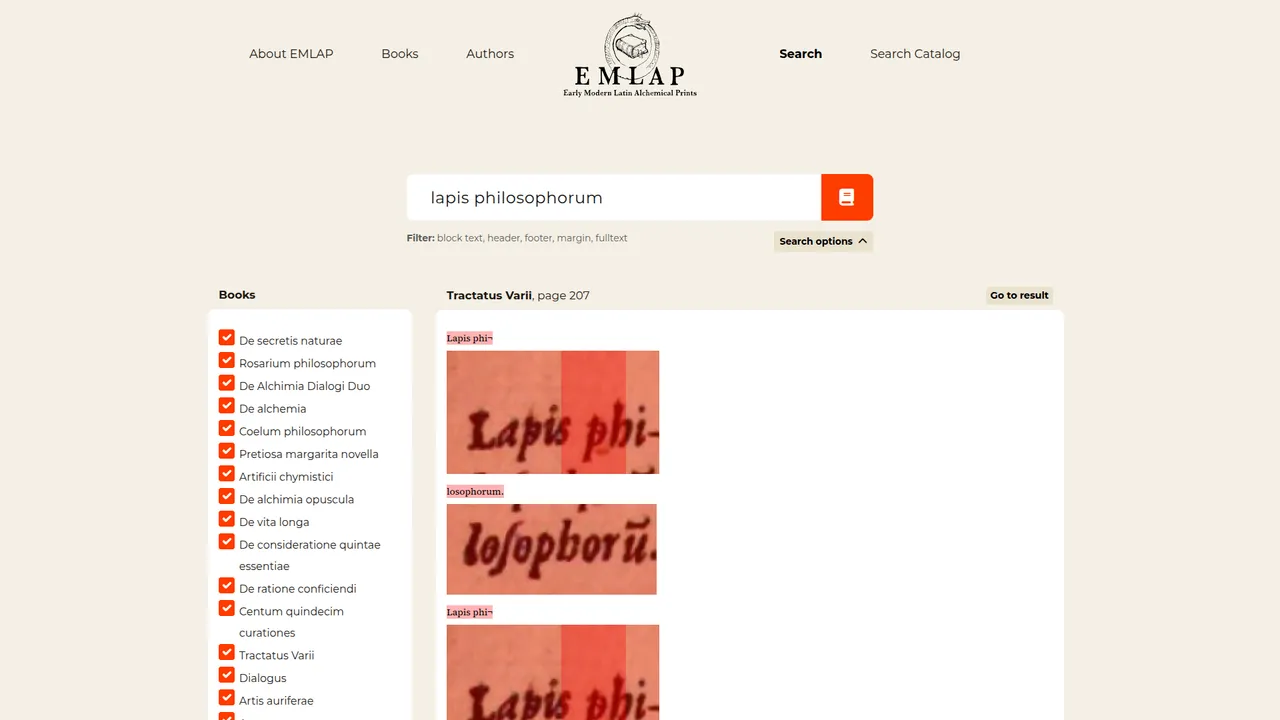
Search covers the text of every page, and separately the main text, header, footer and marginal notes – researchers choose where to look. It finds an exact phrase, the start of a word or similar forms, and results can be narrowed to selected books. Every hit shows a crop of the original scan with the word highlighted.
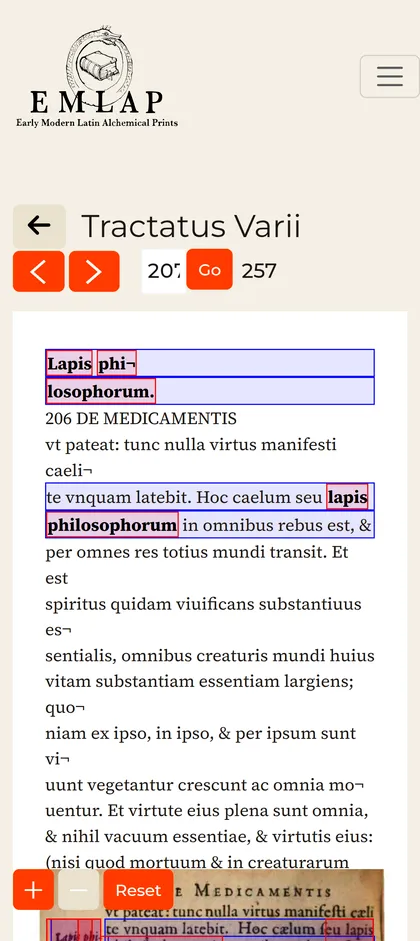
A result opens the whole page: a zoomable scan, the transcription beside it and the found words highlighted in both. Hovering over a word in the transcription shows its place on the scan and vice versa. Alongside full-text search there is a catalogue of prints with authors, publishers, places and years of publication, and a selection by these details.
- 100
- alchemical prints in the corpus
- 1500–1650
- years of publication
- 4
- page parts searchable separately
- 40+
- authors in the catalogue
From the printed page to the word found
The institute transcribes each print in Transkribus, where every line and word gets coordinates on the scan. The application imports the transcription, joins words split at line ends and stores the page text in the search index part by part. A hit is then shown as a crop of the original scan with the word highlighted.
Six areas the search is built on
From importing transcriptions to the page where researchers see their hit.
-
Full text across the corpus
Exact phrase, word start or similar forms. Search can be narrowed to selected books and to a part of the page – main text, header, footer or margin.
-
Page viewer
A zoomable scan with a layer of lines and words, and the transcription beside it. Found words are highlighted in both, and hovering over a word shows its counterpart.
-
Import from Transkribus
Transcriptions in ALTO format are loaded page by page into lines and words with coordinates. Regions marked in the data then assign words to the main text, header, footer or margin.
-
Book, page, line, word
The corpus is stored down to individual words and their position on the scan. That is why a hit can be shown in the original print, not just in the transcribed text.
-
Catalogue of prints
Details of every book: authors, editors, publisher, place and year of publication, genres and subjects, links to VIAF and Noscemus, and a download of the whole book as PDF.
-
Selection by catalogue
Prints can be selected by author, editor, publisher, place, year and subject. Values that would leave no book with the current selection are greyed out.
How the project runs today
On the institute's servers
The application runs on the servers of the Institute of Philosophy. We deploy new versions ourselves and run our own development version, where we try out new features before they reach researchers.
Search by lemma in preparation
We keep working on the application. We are preparing a bulk import of whole books and search by lemma – the base forms of words from the CCS lab data – which also finds the other forms of a word.
Looking for a reliable partner?
Get in touch with no obligation – a few sentences about what you are dealing with are enough, and you will learn whether we can help, what it might cost and what is needed to get started.